
Biometric payments in Russia: how bio‑acquiring works and what is needed to implement it.
The Russian market of cashless payments continues to develop: along with bank cards, the Fast Payment System (SBP), QR codes, and other alternative tools are playing an increasingly important role. One of them is payment using biometrics, which allows you to make purchases without having either a card or a smartphone with you.
According to the Center for Biometric Technologies, in the first half of 2026, Russians made nearly 100 million payments using biometrics, with a total amount exceeding 75 billion rubles. On average, about 550,000 such transactions were carried out daily. Although biometric payments have not yet replaced traditional payment methods, interest in the technology among consumers and businesses is growing. For banks and retail enterprises, this is not only an additional payment acceptance method but also an opportunity to develop new services for their customers.
Let’s take a look at how bio‑acquiring works, where it is used, and what needs to be taken into account when implementing it.
What is bio‑acquiring and how does it differ from other payment methods?
Biometrics (or biometric data) is a set of unique physical or behavioral characteristics of a user. Physical biometric data includes facial images, fingerprints, palm vein patterns, iris patterns, and voice. Behavioral characteristics include gait patterns, handwriting, or typing patterns.
Such characteristics are used for biometric authentication — the process of establishing and confirming a person’s identity. A person’s biometric data is uploaded to a database (for example, the Unified Biometric System) and serves as a reference.
In the payment sector, the most popular scenario for using biometrics is paying for goods and services “by face.” This method is also called biometric payments or bio‑acquiring. The buyer doesn’t need to touch a bank card, take out a smartphone, or scan a QR code: to initiate a payment, it’s enough to look into the camera of a special terminal. The system verifies the biometric data and transmits the identification result to the payment infrastructure, where the transaction processing continues.
At the same time, it’s important to distinguish between biometric identification and the payment itself. Biometrics helps verify a customer’s identity but does not replace the payment infrastructure: the transaction is still linked to the bank and acquiring services. Therefore, bio‑acquiring is not just face recognition or unlocking a device with a fingerprint; it is a separate payment scenario in which biometric identification is used to confirm a purchase.
How bio‑acquiring works: the path from the terminal to the Unified Biometric System
Compared to paying with a card, a smartphone, or via a QR code, biometric payment reduces the number of actions required from the customer.
Biometric payment combines several components of the payment and biometric infrastructure. In a typical scenario, a terminal with a camera, a commercial biometric system (CBS), a biometric gateway, the state Unified Biometric System (GIS UBS), and a bank that processes the payment are involved. Let’s look at how they interact when making a purchase using facial recognition.
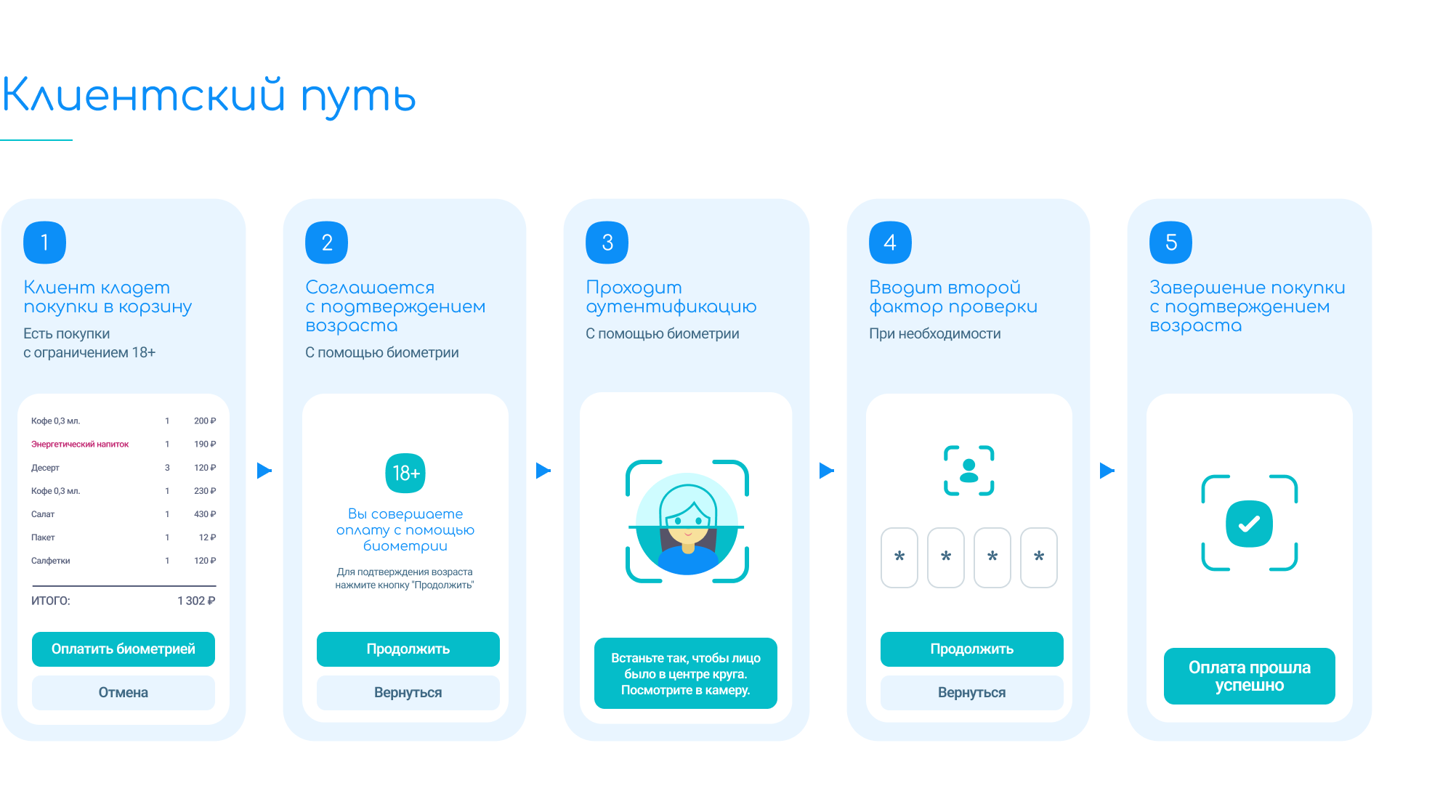
- The buyer chooses to pay using biometrics. At the checkout or self‑service terminal, the person selects the appropriate payment method. As a rule, a photo is used as biometric data. The person looks into the device’s camera. The terminal receives the face image required for the biometric verification.
- The image is transmitted to a commercial biometric system. CBS is a state‑accredited private platform that handles biometric data and provides user authentication. It uses mathematical face vectors (models) obtained from the GIS EBS. The system compares the data received from the terminal with the registered biometric samples to verify the user’s identity.
- The CBS interacts with the GIS EBS. The state system acts as the source of registered biometric data. At the same time, the commercial system does not store the original biometric images in their pure form: protected mathematical vectors and templates are used for comparison. The verification result is then passed on to the payment infrastructure.
- The biometric gateway transmits the identification result. A gateway, such as “Bio Connect,” enables data exchange between biometric and payment infrastructure. In the model under consideration, it receives the verification result — the customer identifier, and in the age verification scenario, also information about the age category — and transmits it for further processing.
- The bank processes the payment transaction. The received information is used within the configured payment scenario, and the bank performs its main function — processing and conducting the payment. If biometrics are used to verify age, the verification result can also be used in the trading scenario to determine whether it is possible to sell a product with age restrictions.
The specific sequence of data exchange and the distribution of functions may vary depending on the solution architecture and the integrations of the bank, terminal equipment, and trading system. Therefore, when implementing bio‑acquiring, it is important to determine in advance which components are involved in the process and which operations each of them is responsible for.
What a bank needs to implement bio‑acquiring
To launch bio‑acquiring, the bank needs to integrate biometric services with the existing payment infrastructure. Depending on the architecture, a commercial biometric system (CBS), a biometric connector, a gateway, modifications to the processing and terminal software, as well as an update to the terminal fleet may be required.
One option is to create the infrastructure independently. This gives the bank more opportunities to adapt the solution to its specific needs, but it requires the development and integration of individual components. In addition, it will be necessary to take into account the requirements for information security, the processing of biometric data, and compliance with the law.
The alternative is ready‑made technological solutions, such as “Bio Connect,” which already include a biometric gateway and interfaces for interacting with common processing systems and terminal software. In this model, the bank doesn’t need to develop all the components on its own: part of the infrastructure and integration tasks has already been handled by the supplier. This allows reducing the amount of custom development work and simplifying the service integration.

In any case, the bank needs to check the compatibility of the solution with its infrastructure, ensure information security, and comply with legal requirements. Ready‑made components simplify implementation, but they do not relieve the bank of its responsibility for properly organizing processes and protecting information.
What opportunities does bio‑acquiring offer to banks, businesses, and customers?
Biometric payments can be useful to all participants in the payment chain, but each has its own specific tasks.
- For customers, it is an additional payment method without a bank card or smartphone. Biometrics simplifies the purchasing process and reduces the number of steps at the checkout.
- For retail businesses, this is an opportunity to speed up service, especially in stores with a large flow of visitors and at self‑service checkout points. Another scenario is confirming age when purchasing goods with restrictions: with appropriate integration, biometric verification can reduce the workload on staff.
- For e‑commerce and marketplaces, this provides additional opportunities for identifying customers and confirming age in online scenarios where this is required by law. In the long term, the development of such solutions could become the basis for new formats of interaction between marketplaces, delivery services, and customers.
- For banks, this is a way to expand the range of acquiring services and offer trading partners additional tools for working with customers. This is also an opportunity to differentiate the offering and strengthen relationships with businesses.
Thus, the value of bio‑acquiring is determined by the tasks the technology helps banks and trading enterprises solve and by how much it is in demand among users.
Biometric payments are not only an alternative payment method but also a technology that can enhance customer scenarios and help businesses solve specific operational tasks. At the same time, successful implementation depends on the choice of architecture, the readiness of the infrastructure, real demand, and a clear economic model.
Blog
Payment via SBP in foreign browsers: why install Russian certificates
How to switch to a domestic DBMS without data loss
How BLE payment works and why it’s needed
In‑house or outsourcing: what to choose for DBMS support