

In‑house or outsourcing: what to choose for DBMS support
In modern business, data is becoming one of the main competitive advantages. It is precisely this data that helps make well‑considered management decisions, build analytics, identify trends, and improve process efficiency.
Therefore, when a business leader or IT director faces the question: “To whom should we entrust the databases for administration?” — this decision should be approached strategically. The stability of system operation, data accessibility, and, ultimately, the continuity of business processes depend on who is responsible for supporting the DBMS.
Over more than 10 years in the outsourcing development and fintech market, we have had the opportunity to work with companies of various sizes and representatives of different industries. And we can say with certainty: there is no universal solution here. Not every company needs its own DBA team, and it’s not always advisable to involve an external specialist for every task. In some cases, it’s more effective to develop expertise within the company; in others, it’s faster and easier to outsource DBMS support to an external contractor.
In this article, we will examine the differences between in‑house and outsourcing approaches to administering and supporting DBMSs, what tasks can be delegated to an external team, and in which cases it makes sense to form your own DBA team.
Let’s fix the terminology: what is outsourcing database administration?
Before comparing in‑house and outsourcing, let’s briefly define what exactly is meant by DBMS administration. For companies that have been working with databases for a long time and have a DBA on staff, the further discussion will likely be obvious. But if administering a DBMS and engaging external specialists is a new task for you, you should first get to grips with the terminology and the scope of work. Let’s briefly go over the main concepts, and then move on to the main question of the article — what is the difference between in‑house support and outsourcing, and which model to choose for a specific business.
A database is an organized repository of information about a business: customers, products, orders, transactions, and other operations. It is in databases that a significant portion of the information is stored that both company employees and applications work with on a daily basis.
A database management system (DBMS) is software that allows you to create and modify databases, run queries on them, manage access, and ensure the safety of the information. Common DBMSs include PostgreSQL, MySQL, Microsoft SQL Server, Oracle, MongoDB, ClickHouse, and other solutions.
If you want to learn more about what a DBMS is, how it works, and what types of systems exist, we recommend reading our separate article “DBMS: what it is, how it works, and what types there are?”
DBMS administration is a set of tasks that helps keep databases stable, secure, and performant. It may include monitoring, backup and recovery, performance tuning, access management, software updates, troubleshooting, configuring fault tolerance, and other tasks.
Database administration outsourcing is the transfer of part or all of the tasks related to supporting and managing a DBMS to an external contractor. Instead of building its own DBA team, the company engages specialists with the necessary expertise and assigns them an agreed scope of work: for example, 24/7 monitoring and support, backup, performance optimization, maintenance of updates, or resolution of emergency situations.
At the same time, outsourcing does not necessarily mean a complete transfer of database management. The company can retain its own IT team and engage external specialists only for specific tasks or additional expertise. We will examine this approach in more detail later.
What can database outsourcing be like?
There are four main formats of cooperation. The choice depends on which tasks the business is willing to outsource and which it wants to keep under its own control.
Full outsourcing. The contractor is responsible for everything: installation, configuration, 24/7 monitoring, backups, security, and development. It is suitable for companies without an in‑house DBA or for those who want to completely offload the technical function.
Partial outsourcing. The external team handles specific tasks — for example, night shifts, monitoring, or backup. It’s convenient when you have your own specialists internally, but you lack the resources or expertise in a particular area.
Project-based outsourcing. One‑time work with clear deadlines and results: migrating from Oracle to PostgreSQL, implementing a fault‑tolerant cluster, conducting a security audit, optimizing performance. After the project is completed, the cooperation may end or transition to support.
DBA as a Service (subscription). A fixed monthly fee for a service package with a pre‑agreed SLA. Transparent budget, predictable expenses, quick start — this is the format most often chosen by medium‑sized businesses and growing SaaS companies.
In practice, these models are often combined: for example, a business orders a project migration and then switches to partial support.
When to choose outsourcing
When a business comes to us for the first time with a request for outsourcing — regardless of whether we’re talking about DBMS or software development — managers have a reasonable question: “What exactly will be done for me?” Formally, everything sounds quite obvious: “administration, support, optimization.” But outsourcing DBMS administration is not just about delegating individual technical tasks to an external specialist. Essentially, your company gains access to a ready‑made DBA team that can take care of regular database support, monitoring, backup, performance tuning, updates, and incident resolution.
For businesses, this format can be especially convenient when an internal team hasn’t yet been formed, certain competencies are lacking, or the company needs support that is difficult to provide with just one or two full‑time specialists.
Let’s look at the advantages of outsourcing a DBMS.
1. Access to ready‑made expertise
There’s no need to independently search for a DBA with the required set of competencies, build a team, conduct onboarding, and accumulate expertise. When working with a specialized contractor, the company immediately gets specialists who regularly handle DBMS administration tasks and are familiar with various database usage scenarios.
This is especially relevant when the infrastructure is built on several DBMSs or when narrow competencies are periodically required — for example, to optimize performance, configure fault tolerance, or carry out migration.
For example, on September 29, as part of the webinar “DBMS Support during the Import Substitution Period: Audit, Migration, and Pitfalls,” our experts will share case studies of companies from the healthcare and finance sectors transitioning to domestic solutions.
2. A team instead of one specialist
A single in‑house DBA cannot be available around the clock, handle ongoing tasks, participate in projects, and cover for a colleague during vacation or illness. An external team allows the workload to be distributed among several specialists.
This reduces the business’s dependence on a specific employee and simplifies the organization of 24/7 support, provided that such a format is stipulated in the contract and the SLA.
3. A more flexible cost model
Under the in‑house model, the company incurs fixed costs for maintaining employees regardless of the current volume of tasks: salaries, taxes, training, and professional development. With outsourcing, the volume of support can be tailored to the business’s actual needs.
For example, some tasks can be assigned to a contractor on a permanent basis, while individual specialists can be engaged only for the duration of a project, migration, or to solve a complex technical problem.
4. Scaling without expanding the staff
If the number of databases grows, a new DBMS appears, or the volume of tasks increases, the internal team has to hire new specialists. In an outsourcing model, scaling can be organized faster: increase the volume of support, add additional competencies, or strengthen the team for a certain period.
Right Line already has more than 300 specialists on staff, and many of them work with databases and are involved in administering databases of varying “capacity”.
5. The opportunity to outsource routine tasks and focus on the business
Monitoring, regular maintenance, backup, database health checks, and handling typical incidents require constant attention, but they are not always the key task of the internal IT team. And certainly, this is not the main area of interest for the business.
By outsourcing such work to an external contractor, the company can give its internal specialists more time to develop infrastructure, products, and business systems.
Why choose in‑house?
The outsourcing model also has limitations that it’s important to consider before starting cooperation.
1. Dependence on an external contractor
The more tasks are outsourced, the more the company depends on the quality of the partner’s work. If the contractor has poorly structured processes, takes too long to respond to incidents, or lacks the necessary expertise, this directly affects the operation of the infrastructure.
Therefore, before starting cooperation, it is important to define in advance the areas of responsibility, the escalation procedure, the response and recovery time, the scope of work, and other SLA parameters.
2. The need to convey context to the contractor
An external DBA does not know the company’s infrastructure as deeply as a specialist who works with it every day. At the start, time will be needed for an audit and onboarding: studying the architecture, documentation, specifics of particular databases, security settings, and internal processes.
For the same reason, up‑to‑date documentation and a clear knowledge transfer process are important — especially if the contractor’s team composition changes later on.
3. Security and access issues
To administer databases, external specialists will, in some cases, need access to the infrastructure. For companies that work with sensitive information, this may become one of the key issues when choosing an outsourcing model.
Therefore, it is important to determine in advance what specific access rights the contractor needs, how these are provided and monitored, who is responsible for the specialists’ actions, and how changes are recorded.
4. Communication and response speed
The outsourcing team is located outside the company, so it is important to agree in advance on the format of interaction. Who accepts the request? Who should be contacted in case of a critical incident? Who has the authority to make changes to the production environment? How quickly should the contractor start work?
The more critical the DBMS is to the business, the more important it is for these processes to be formalized and not depend on personal agreements. This is always discussed upfront.
In-house or outsourcing: a comparison based on key criteria
No fluff — just a comparison based on key criteria.
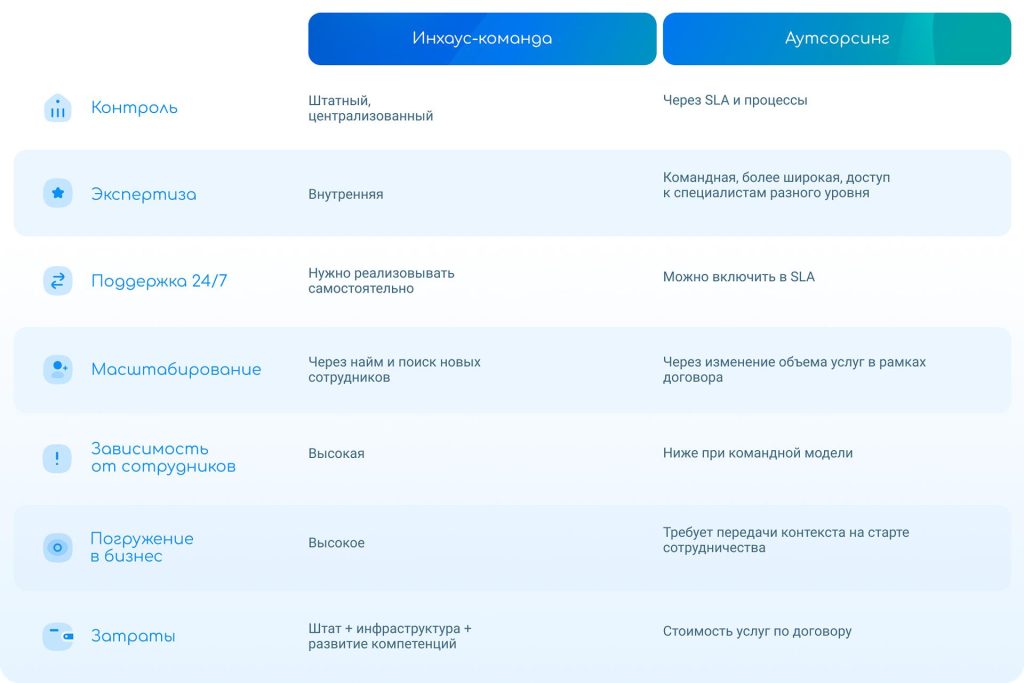
In-house can be justified if:
- DBMS is critical to the business;
- the infrastructure is complex and constantly evolving;
- DBA works closely with internal development;
- the company needs ongoing internal expertise;
- there are resources for a full-fledged team.
Outsourcing may be suitable if:
- a separate DBA team is not economically viable;
- comprehensive expertise or in-depth knowledge of a specific DBMS is needed;
- 24/7 support is required.
- It is necessary to quickly strengthen the existing team;
- the number of tasks changes significantly over time;
- the company wants to focus internal resources on the main IT product.
How much does DBMS administration cost?
Outsourcing DBMS is not a “magic pill” and not a way to turn a blind eye to internal processes. If the company does not understand what tasks need to be solved, why they are needed, and what exactly is being handed over to the contractor, no external team will be able to fully address these problems.
Therefore, when choosing between in‑house and outsourcing, it’s important to look not only at the cost of services or hiring specialists. The scale and complexity of the infrastructure, the number of databases, the requirements for availability, the need for round‑the‑clock support, the level of required expertise, and potential business risks all matter.
The cost of such support depends on which specific tasks need to be outsourced, how many databases are in the system, which DBMSs are used, and what level of support is required. Therefore, assessing costs based solely on the cost of a single specialist is not entirely accurate.
To understand how much it might cost to manage your specific infrastructure, we have prepared a short questionnaire. Fill it out — and get an estimate of the cost of supporting your DBMS, taking into account your tasks and requirements.
Blog
What’s new in SBP: how the system will work in 2026–2027

Smart contracts in digital rubles: what they are and what they are for

Digital ruble theft: what scammers face and how the law protects a new form of money

Where are biometric payments taking root the fastest: transport, retail, or cafes?