

Lifestyle Banking: How to Turn Mobile Banking into a Super App and Increase Customer LTV
Russian Big Tech continues to amaze with its achievements. According to the latest data from Smart Ranking, the combined revenue of Russia’s largest tech companies will grow by more than a quarter in 2025, reaching almost 9 trillion rubles. This figure is impressive in itself, but the question arises: “What exactly drove this growth?”
According to analysts, the main contributors were proprietary digital products, platforms, and the strength of companies’ ecosystems. When various digital services and platforms are linked by a common customer base, data, and infrastructure, monetizing areas such as fintech, e-commerce, media, cloud, B2B services, logistics, and advertising becomes easier. After all, ecosystems keep clients connected and enable business scaling by penetrating everyday consumption patterns.
The largest Russian banks have long been part of Russian Big Tech and were among the first to embrace lifestyle banking. Their mobile apps are no longer just “digital wallets,” but full-fledged everyday life platforms. This shift is no accident and reflects the overall market trend, where the ecosystem is becoming the primary asset.
A logical question arises: if market leaders have already built full-fledged lifestyle platforms around their remote banking services, why should other players follow suit? And what benefits does this provide for banks and their clients? Let’s examine these in turn: what is lifestyle banking, how is the mobile banking economy changing, what scenarios it addresses today, and what is needed to transition to a new model.
What is lifestyle banking?
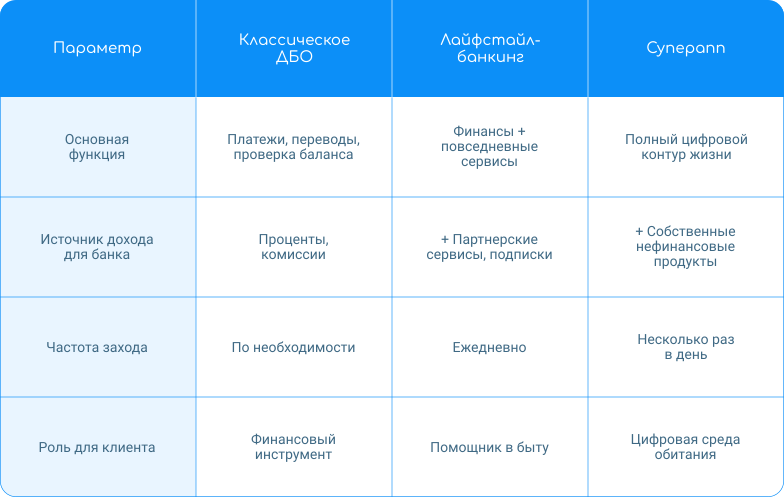
Lifestyle banking is a model in which a banking app ceases to be simply a tool for payments and transfers and becomes a platform for everyday services: shopping, subscriptions, travel, insurance, home and car services.
5 Reasons Why Banks Are Shifting to a Lifestyle Banking Model
The financial market is logically responding to modern demands: over the past 5-7 years, Russian users have become accustomed to solving most of their problems within a single digital environment. Marketplaces, delivery, and service ecosystems have created a new behavioral pattern: a service must not lose customers and send them elsewhere.
Let’s examine five key factors that make this transition inevitable for banks seeking to maintain customer loyalty.
New Revenue Streams. In an environment where a bank relies solely on interest income and basic fees, its business model simply hits a revenue ceiling. The lifestyle model opens up new sources: affiliate commissions, commissions on new transactions, paid subscriptions, and cross-selling of non-financial services.
Competition for customer attention. By 2025, more than 2.17 billion people worldwide will use mobile banking—an increase of almost 35% over five years. In Russia, over 60% of active users access banking apps daily. But customer attention is limited, and the battle for every minute of screen time is no longer between banks, but between apps. Those who complete more daily tasks win in frequency of interaction—and, consequently, revenue.
Multi-banking as the new norm. The average customer today has two or three banking apps and easily switches between them depending on the terms of a specific transaction—cashback, exchange rates, or limits. Retaining them with “deposit interest” is becoming more difficult. However, retaining them with unique non-financial experiences is quite possible. Lifestyle services are becoming the very “hook” that keeps customers coming back to a particular app.
App fatigue. The behavioral trend of recent years is simplification and visual minimalism: people prefer a single app that handles multiple tasks to several specialized ones. Total revenue in the global mobile banking market already exceeds $1.9 trillion, and the lion’s share of this is accounted for by players building an ecosystem rather than a single-product approach.
The Impact of Marketplaces and New UX Expectations. Marketplaces and major tech platforms have redefined the standard of user experience: seamless payments, personalized recommendations, one-click delivery, and a single shopping cart for multiple categories. Customers are transferring this standard to all other apps, including banking apps.
Lifestyle Banking Economics: From Transactions to LTV
We’ve covered the reasons for the transition—now let’s take a closer look at how banks will make money in the new environment.
In traditional remote banking, the profit logic is simple and linear:
- interest income from the difference between deposit and loan rates;
- transfer fees, account maintenance, and acquiring;
- one-time product sales—cards, mortgages, insurance.
The problem is that this model hits two ceilings simultaneously: limited margins on transactions and a limited number of active clients. Growth can be achieved either by luring clients from competitors (expensive) or by raising rates (risky).
Lifestyle banking views the client differently. The primary metric is not the transaction, but LTV (Lifetime Value), the cumulative value of a client over their entire life in the ecosystem. And there are significantly more sources of income:
- Financial products remain the bank’s core, but now they are sold at the right moment in life. A loan when viewing a car on the marketplace, insurance when buying tickets.
- Partner commissions – the bank receives a share of every purchase within integrated services: delivery, taxi, tickets, hotels.
- Subscriptions – a single paid subscription combining increased cashback, free partner services, and premium support.
- Advertising and partner promotion – the bank is transformed into a media platform with unique targeting based on real financial behavior.
- Data and personalization – monetization of the precision of offers: the better the bank knows the client, the higher the conversion rate of each communication.
Where do merchants benefit?
First, it’s an identified customer with a clear financial history. Unlike traditional digital channels, where operations are based on probabilistic models and hypotheses, the bank operates with real data on the user’s income, expenses, and payment patterns.
Second, the banking app already has a built-in payment instrument. The customer doesn’t need to enter card details, go through additional steps, or navigate to third-party services—the path to making a purchase is as short as possible. This directly impacts conversion.
Finally, trust plays a crucial role. The banking app is perceived as a safe and familiar environment in which the user already regularly makes transactions. This reduces barriers to purchase and increases willingness to engage with new services within the ecosystem.
A very important advantage is personalization. The bank can make contextual offers: insurance after purchasing a ticket, car service after paying for gas, subscriptions—at the time of regular expenses.
But it all starts with the Back Office.
In practice, scaling such ecosystems faces a less visible but extremely serious challenge: the technological legacy of banking systems. When talking about lifestyle banking, they typically showcase a beautiful app interface, but behind this veneer often lies a complex set of legacy IT solutions, integrations, and manual processes.
A bank’s back office is what makes every operation in the app possible: it processes transactions, reconciles data, calculates fees, and interacts with partners and payment systems.
The tasks of the back office in a lifestyle model are dramatically more complex: instead of processing transfers and payments, it handles dozens of partner integrations, acquiring, online payments, subscriptions, and non-financial services. Every new front-end scenario creates a new data flow that someone must process correctly.
Therefore, modern IT solutions for banks are built from the inside out: first, the core and back office services are modernized. Without this foundation, no lifestyle solution will function properly—it will simply run into manual operations and failures. First and foremost, a specialized back-office solution will be required, capable of managing settlements, commission logic, and partner interactions. These are precisely the areas of active development for tech companies.
Conclusion
Thus, today’s banking applications are no longer simply a transaction channel but are becoming a platform for the client’s daily life. This is where financial and non-financial scenarios converge, the user experience is formed, and a new banking economy is established.
However, the sustainability of this model is determined not only by the front end—a user-friendly interface and a range of services—but also by what lies behind it. The scalability of an ecosystem directly depends on how efficiently internal processes are structured: settlements with partners, commission management, billing, and integrations.
Therefore, the development of modern banking ecosystems is impossible without a back-office transformation. Such solutions become the foundation for the growth of lifestyle ecosystems and enable banks to realize the full potential of this new model.
Blog

Where are biometric payments taking root the fastest: transport, retail, or cafes?

DBMS: what is it, how does it work, and what types are there?
Digital Ruble in 2026: which companies are required to accept it

Why development deadlines are falling short: the main problems of IT outsourcing and external teams