

DBMS: what is it, how does it work, and what types are there?
When it comes to modern information technologies, one of the basic concepts invariably becomes a database management system. It is thanks to these software solutions that millions of companies around the world are able not only to store, but also to efficiently process huge amounts of data, from order history in online stores to medical records and banking transactions.
Decoding and essence of the concept
A DBMS (database management system) is a specialized software whose task is to organize work with data, store, search, update and delete it. In other words, a DBMS is a kind of “invisible conductor” that controls all the processes of information movement within your company.
It is important to distinguish between the concepts of “database” and “database management system”.
A database is a repository of ordered information structured in a special way. It may contain records of customers, transactions, goods, or other resources important to the business.
A DBMS (database management system) is a tool that provides access to and processing of this data through an interface, program commands, or automated scripts.
To understand what these terms are in practice, we can draw an analogy: if a database is a huge digital library, then a DBMS is a system of electronic catalogs and librarians that allow you to quickly find the right book, give it to your hands, add or remove a copy, and ensure the safety and integrity of all data.
In everyday life, interaction with a DBMS is invisible to the end user. For example, when you order an item from an online store, your request instantly passes through the database: the system finds the desired item in the catalog, checks stock availability, updates order data, and stores the entire history of your purchases.
The main tasks of the DBMS
The main functions of the database management system are as follows:
- Organization of the data storage structure (creation of interconnected tables, documents, graphs).
- Providing quick access to information even with simultaneous requests from a large number of users.
- Data processing (modification, deletion, filtering, sorting by specified criteria).
- Information security and safety: access rights differentiation, backup, protection against unauthorized access.
- Integration with other services (information exchange between different business applications and systems)
Without a reliable and functional DBMS, it is impossible to build a modern IT infrastructure, ensure the operational operation of a website, application, or corporate system.
How does a DBMS work?
At first glance, interacting with digital data seems simple.: we enter a query on the website, and in a split second the necessary information appears on the screen. However, behind this apparent simplicity is a complex database management system that provides fast and secure access to vast amounts of information.
During operation, the DBMS acts as an intermediary between the user (or program) and the data warehouse. According to the classical scheme, the architecture of the system consists of several levels:
- The user interface is what a person encounters when working with an application or website.
- The software server is the “heart” of the DBMS, accepting requests (for example, searching or updating data), analyzing them and returning the results.
- A database is an organized repository where data is structured in tables, documents, or other formats.
You can describe the principle of operation in a few simple steps.:
- The user or the program generates a request. For example, it may be a desire to find out the account balance or to find a product by category.
- The request is sent to the server, where the DBMS “reads” it: it parses it into commands and determines which parts of the database need to be “visited”.
- Performing searches or other operations on data: The DBMS accesses the database, finds and extracts the necessary information, or modifies existing information.
- The results are returned to the user or the program. For example, a list of products appears on the website, an order confirmation is sent to the mail, and the current balance is displayed in the mobile bank.
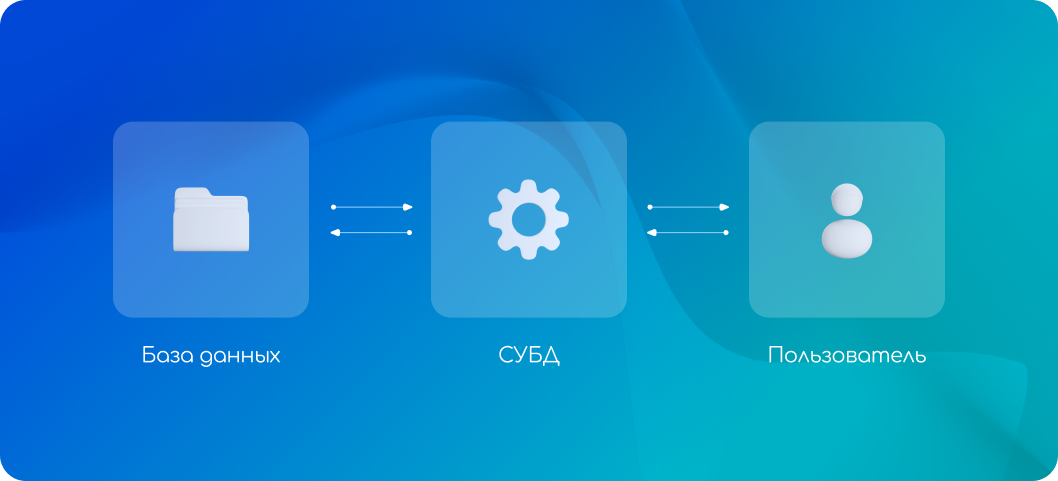
Due to special algorithms and optimization, the DBMS is capable of processing thousands — and sometimes millions — of simultaneous requests. This is necessary for the smooth operation of large online stores, social networks, banking systems and other services whose users are active 24/7.
Modern databases support working with large amounts of information and allow you to scale the system to meet growing business needs. If there are more clients, the load increases, and the DBMS adapts using additional servers, caching, and query allocation.
The main types of DBMS
The variety of tasks faced by modern business has led to the emergence of many database management systems. To choose the right solution, it is important to understand what types of databases exist today.
Conventionally, all database management systems can be divided into three large groups: relational, non—relational (NoSQL), and a relatively new class, NewSQL.
Relational databases
Relational Database Management Systems (RDBMS) are considered the “gold standard” in the world of data storage. The information in them is presented in the form of tables, between which logical connections are established. This model is useful when structure and accuracy are important: for example, in financial accounting, HR records management, or CRM systems.
The main tool for working with relational databases is the Structured Query Language (SQL). You can use it to create tables, add and edit records, and create complex selections and reports.
Popular relational databases: MySQL, PostgreSQL, Oracle Database, Microsoft SQL, SQLite.
Non-relational databases (NoSQL)
Their name stands for Not Only SQL — “not only SQL”, which emphasizes the diversity of approaches to data organization.
The main advantages of non-relational databases:
- working with unstructured and semi-structured data (JSON, XML, texts, images, videos);
- horizontal scaling — the ability to distribute the load between dozens and hundreds of servers;
- high query processing speed;
- A flexible data model that adapts easily to changes in business logic.
NoSQL databases are divided into several subcategories, each of which is focused on its own use cases.
Documented ones. They store data in the form of independent documents in the JSON or BSON format. Suitable for content projects, catalogs, and document management systems.
The key is the value. The simplest, but extremely effective model, where each record has a unique key. They are used for caching and storing sessions and message queues.
Columnar (column-oriented). They are optimal for analytical tasks and processing large amounts of “heavy” data.
Graph numbers. They focus not so much on the data itself as on the connections between them. They are indispensable where it is important to analyze complex relationships: social networks, recommendation systems, and anti-fraud services.
NewSQL
Another dynamically developing area is NewSQL systems. They strive to combine the reliability and familiar principles of the relational model with the flexibility and scalability of NoSQL.
In other words, such databases allow you to work with familiar SQL and support ACID transactions, but at the same time they can easily cope with growing loads and horizontal scaling.
Things to remember about DBMS
Today, DBMS is the foundation of the digital economy, which supports online shopping, banking services, social networks, government platforms and thousands of other solutions that have become part of everyday life.
When choosing a DBMS, it is important to take into account not only the current tasks of the project, but also its prospects: the expected increase in workload, requirements for response speed, the level of data criticality and budget. A well—chosen system becomes not just a repository, but a full-fledged development tool – it accelerates business processes, improves the quality of customer service and creates the basis for deep analytics.
Blog
What’s new in SBP: how the system will work in 2026–2027

Smart contracts in digital rubles: what they are and what they are for

Digital ruble theft: what scammers face and how the law protects a new form of money

Where are biometric payments taking root the fastest: transport, retail, or cafes?