
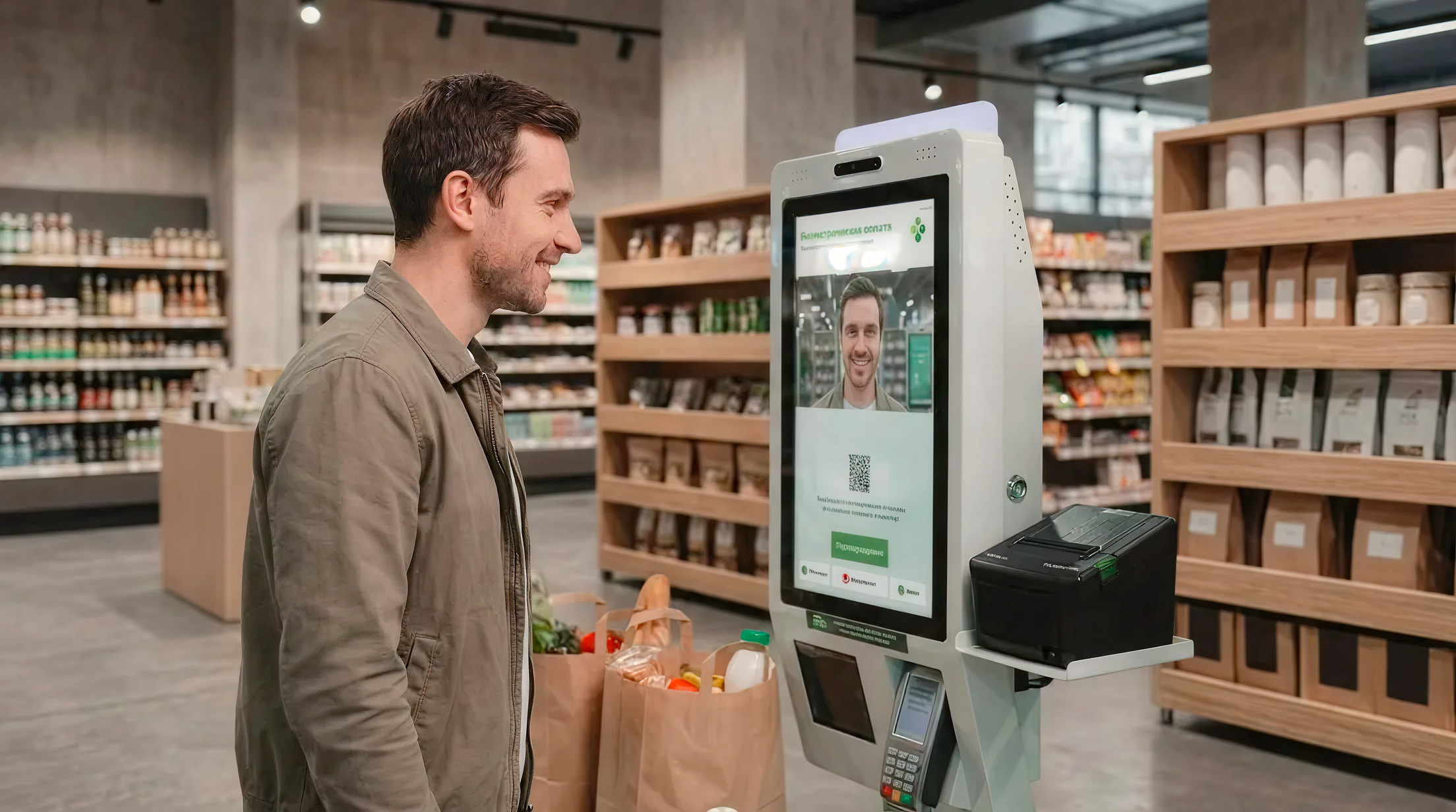
Biometric payment in retail: how banks and stores simplify the customer’s journey
Payment without a card or phone, automatic age verification and minimization of queues — bioequipping changes the usual scenarios at the checkout. We tell you how the technology is scaling in Russia and what it gives to banks and businesses.
Why payments should be invisible and how bioequaring implements it
In recent years, the user experience in finance has been radically simplified. Customers are used to instant transfers, one-touch payments, and effortless services. Under these conditions, biometrics in financial services logically continues the general trend: payment ceases to be a separate action and turns into a background process.
Modern scenarios for using biometrics for payments are built around minimizing steps. Offline, this is especially critical: a queue, limited time, and the need to get a card or phone. Biometric payment removes unnecessary actions to confirm the customer’s biometric data (for example, face or fingerprint).
This approach changes the very mechanics of human interaction with Yandex. Checkout. The terminal’s camera captures the image, the system checks it against the data in a Single Biometric System, after which funds are debited from the linked account. For the client, it looks like one short gesture or a glance at the camera.
Scaling up biometric payments in Russia
Until recently, biometrics payments were perceived as an experiment, but over the past year the market has passed an important stage — the transition from pilots to industrial operation. Large banks have begun to consistently develop their own scenarios, forming a single user standard and expanding the reach of outlets.
Sber is scaling up “Smile Payment”: over the entire existence of the service, more than 4.4 million Russians have used it, and the number of transactions in just 9 months of 2025 exceeded 132.5 million. Alfa-Bank is testing payment by sight, T-Bank is investing in its own biometric terminals and data collection infrastructure. According to the plans: to increase the number of terminals to 150,000 in 2026. These initiatives show that the biometrics of the bank’s clients is considered as a strategic channel of interaction with the client, including offline.
The key growth factor was the lowering of the entry threshold. Ready-made technological solutions allow banks to launch bioequipping in the bank’s circuit without creating their own complex infrastructure. For example, our Bio Connect solution is already helping several banks to provide the ability to make payments using biometrics.
Biometrics for age verification, not just payment
The development of biometrics in financial services goes beyond payment scenarios. In addition to payment, the technology solves the problem of fast and seamless customer identification offline. The camera and verification with a Single biometric system allow you to confirm your identity in seconds — without documents and staff involvement.
The most understandable and popular scenario is age verification at the checkout when buying restricted goods (alcohol, tobacco, and even in some cases books). Instead of checking the passport and waiting for the administrator at the self-service checkout, the system automatically confirms the age of the buyer. This reduces the burden on employees and eliminates conflict situations, while maintaining a unified user experience.
This model is applicable not only in retail. Bioequaring and user verification using biometrics potentially scales to related areas: transportation, access to events, carsharing, and pick-up points. A universal approach is being formed, where biometrics for digital payments and identification works as a single service, rather than a disparate set of solutions.
The economics of bioequaring for retail
For retail outlets, biometric payments are an operational efficiency tool. Eliminating manual age checks and speeding up payments directly reduce queues and increase ticket office capacity, especially during rush hours.
Automatic identification scenarios remove one of the most painful points of offline retail – the human factor. The absence of disputes with customers and the minimization of delays have a positive effect on the customer experience and reduce the burden on staff.
For the seller, this means an increase in the speed of service without restructuring business processes. Biometric payments are integrated into the existing cash logic and have a measurable effect already at the level of everyday operations.
About user security and trust
The key condition for the spread of biometrics in banks is trust. In current scenarios, security is built into the default process: biometric data is stored in secure circuits, and identification uses liveness detection technologies that exclude image substitution.
An additional level of control is provided by a BIO-PIN, which banks can use as an additional protective mechanism when confirming transactions. This approach reduces risks and makes biometric payments comparable in terms of security with traditional payment methods.
Banks can launch bioequaring now
Enabling bioequaring no longer requires banks to build their own infrastructure from scratch. Ready-made solutions are already available on the market that allow you to connect to the EBS, launch bioequipping and scale scenarios without long development and significant financial costs.
Such solutions simplify the integration of biometrics in banking applications, ensure the correct operation of identification and payments, and enable banks to focus on customer experience.
Lowering the entry threshold makes fast pilots possible. Banks can test biometrics payments in real retail outlets, check demand, collect feedback, and make scaling decisions without the risk of a “long freeze” on investments.
The future of biometrics in offline payments
Offline biometrics has already passed the demonstration stage. The first mass scenario, age identification, is understandable to the market, the user and the regulator. It is he who forms the habit of biometric payments and reduces the psychological barrier to new technology.
Further distribution will depend on three factors: user trust, transparency of processes, and quality of implementation. If bioequaring remains a convenient, safe and predictable operation, it will naturally integrate into everyday scenarios, from supermarkets to urban infrastructure services.
Image source: Generated by the ChatGPT
Blog
Open APIs of the Bank of Russia: Results of 2025, New Deadlines, Updated Standards

The digital ruble in Russia: results of 2025, launch dates and requirements of the Bank of Russia

Development of an online acquiring platform: architecture, payment gateway, Back Office and a turnkey merchant portal
Unified QR Standard: how the payment market is moving to a new infrastructure