

Open APIs of the Bank of Russia: Results of 2025, New Deadlines, Updated Standards
The year 2025 turned out to be a turning point for the Bank of Russia’s Open APIs. In the first half of the year, market participants were preparing for the introduction of Open APIs in the banking sector to become mandatory, in sync with the large—scale launch of the digital ruble in 2026. It was assumed that banks’ Open APIs would become the basic infrastructure for data exchange and the development of Open Banking services. However, in October, the regulator announced the postponement of the deadline.
At the same time, the project’s development did not stop. In December, the Bank of Russia approved and published ten documents that are part of a set of interface standards developed with the participation of the Fintech Association and major market players. The updated Open API standards clarified the requirements for security, interaction formats, and customer consent management. Thus, despite the postponement of the deadline, the regulatory and technological framework for Russian Open APIs continued to be established.
What does the change in the regulatory schedule mean for banks and fintech companies, how will Open API develop in Russia, and what should the market prepare for in 2026?
What are the Open APIs of the Bank of Russia?
The Open APIs of the Bank of Russia are standardized software interfaces that allow banks and other financial institutions to securely exchange data through unified protocols. Open APIs in the banking sector are developed in accordance with the requirements of the regulator and are designed for controlled information exchange between market participants. aggregators, financial assistants, or solutions based on the Open Banking API.
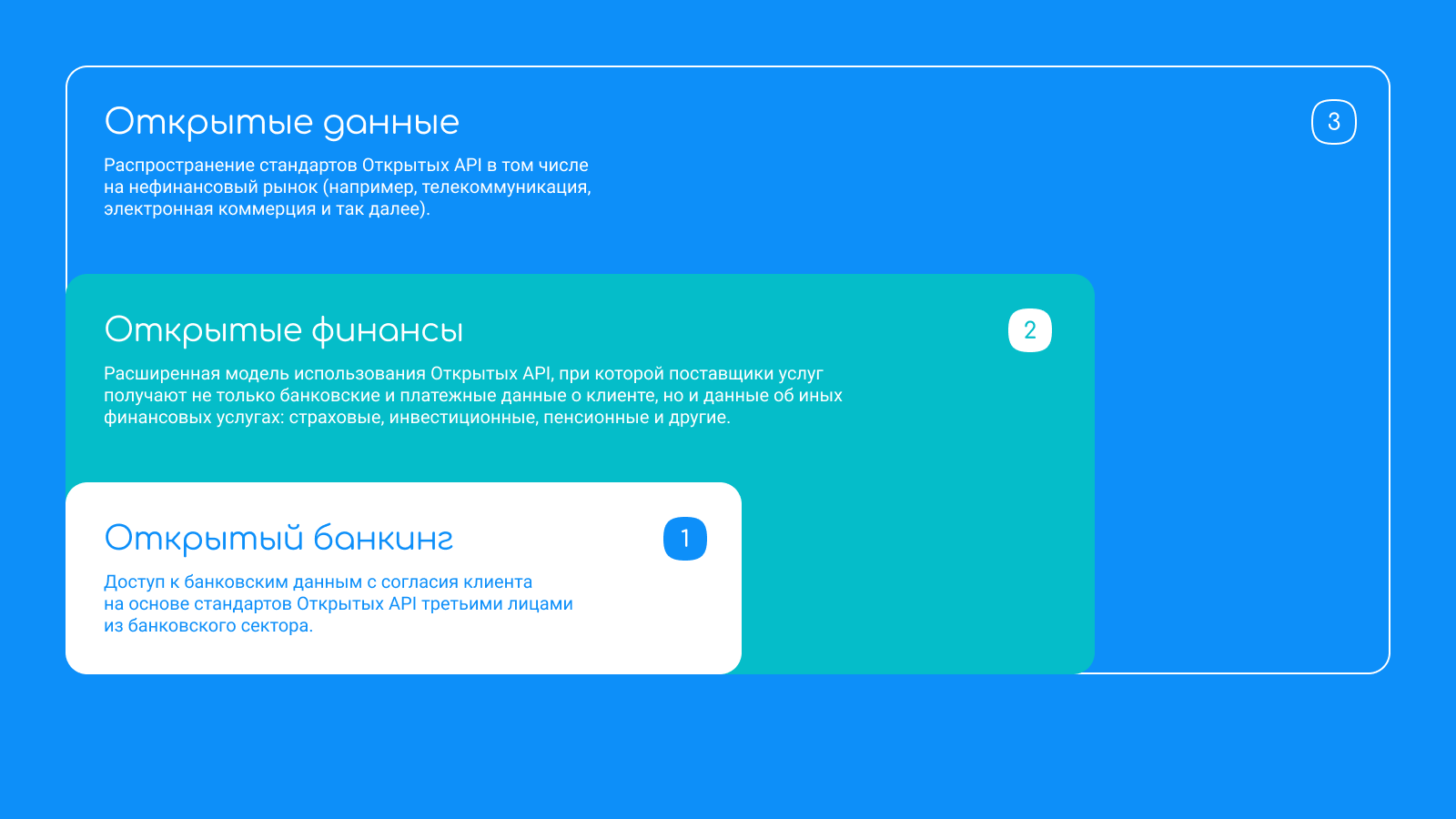
The development of Russian Open APIs began with the publication of recommendatory standards for banks in 2022. Soon after, the Bank of Russia presented the Concept for Implementing Open APIs in the Financial Market, outlining the goals of the initiative, its benefits, and potential implementation models. The document received extensive feedback, with 166 organizations submitting proposals.
Taking into account market comments and global experience, a hybrid approach to implementation was chosen: a combination of regulatory requirements and industry self-organization. It was from this point that the Open API implementation project in Russia moved from the discussion phase to practical implementation and became part of a broader open finance development strategy.
When will the implementation of open APIs in Russia become mandatory?
Until the fall of 2025, it was planned to gradually introduce open APIs in the banking sector: from 2026 for systemically important banks, brokers and insurance companies, and from 2027 for microfinance organizations, depositories and financial platforms. It was assumed that mandatory open APIs would become part of the open banking infrastructure and would be synchronized with the development of other digital initiatives, including the digital ruble.
However, in October 2025, the Bank of Russia announced the postponement of the mandatory implementation of the Open API for the financial market. The new dates will be determined after the adoption of the federal law, which is currently under development. Thus, the question “when will Open APIs be implemented” directly depends on the final regulatory framework.
At the same time, at the recent conference “Cybersecurity in Finance”, Ruslan Bulatov, head of the Central Bank’s Financial Technology department, expressed hope that the launch of information sharing using Open APIs would take place in 2027.
Anastasia Kayuchkina, Director for Open Data and Ecosystems Development at the FinTech Association, noted that 20 banks and companies are already testing unified Open API standards on the AFT platform.
In addition, the first pilot integrations took place back in 2024 and showed practical results. Among the participating banks were Sber with T-Bank, Gazprombank and Sovcombank, VTB, Alfa-Bank and PSB.
Following the pilots, the Bank of Russia noted that large banks are the most ready to implement this technology.
Updating the Open API Standards of the Bank of Russia
The key event of 2025 for the project was the approval of an updated set of open API standards of the Bank of Russia. In December, the regulator published ten documents prepared with the participation of the Association of FinTech and major market participants. Thus, despite the postponement of the mandatory implementation deadline, the development of Russian Open APIs continued at the regulatory level.
The new Open API standards have detailed requirements for information security, access management, and interaction formats between organizations. These requirements include not only technical specifications, but also organizational mechanisms such as the procedures for obtaining and revoking customer consent, authentication procedures, data protection, and access control. Essentially, the regulator has specified the architecture upon which the Open Banking infrastructure in Russia will be built
The emergence of approved standards significantly simplifies the work of technology vendors, allowing them to refine and scale solutions based on a unified architecture, reducing the cost of integrations and shortening the time it takes to bring services to the market.
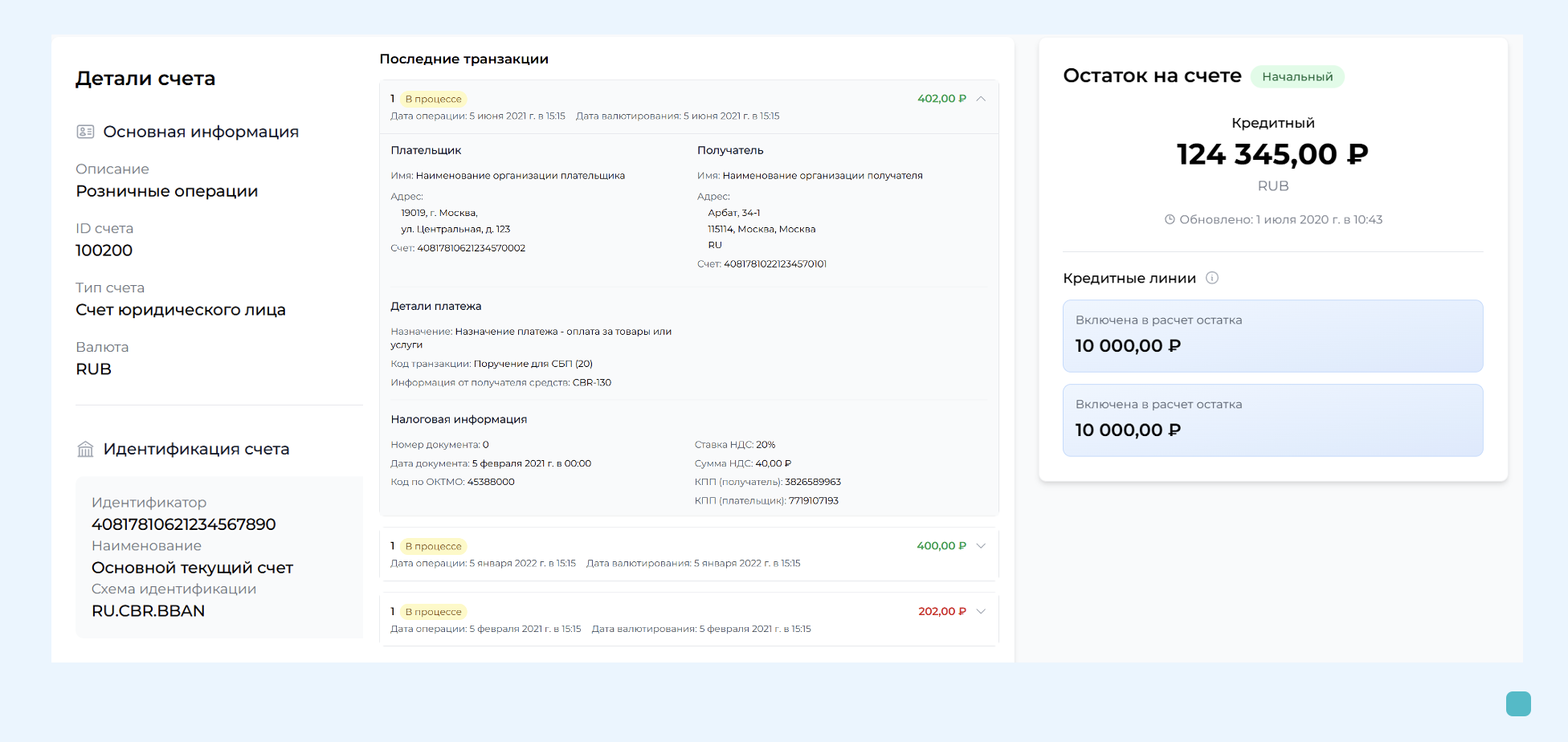
There is already an Open Banking solution on the market from Right line, which is based on the API of the Bank of Russia and the infrastructure platform of the FinTech Association. It is based on a module for managing user consents to access accounts and payments. This tool allows you to automate key processes, such as creating and managing user consents, obtaining information about accounts and transactions, initiating payments on behalf of the customer, and analyzing their financial behavior in different banks, provided that the user has granted consent.
Do I need an operator for Open APIs in Russia?
The development of such a large-scale infrastructure as the Bank of Russia’s Open APIs raises the logical question of the existence of an operator, a structure that coordinates implementation, answers questions from market participants, and ensures the stability of information exchange. In international practice, open banking models often involve a centralized coordinator or platform. In Russia, an official operator for Open APIs has not yet been established.
The Expert Council for the Implementation of Open APIs, which has been operating since 2023 on the basis of the FinTech Association, partially performs the function of a professional coordination platform. Banks, fintech companies, and infrastructure organizations participate in its work. The Council allows for the synchronization of market positions, the discussion of technical aspects related to the implementation of open APIs, and the development of consistent approaches to the application of standards.
At the same time, the Bank of Russia does not plan to create a centralized operator on its own. As First Deputy Chairman of the Central Bank Ruslan Bulatov noted at the Cybersecurity in Finance forum, the law and requirements are formulated in such a way that integrations can be launched without a separate operator, and its emergence is more of a matter of optimizing the costs of information exchange participants.
The regulator expects that, if necessary, the market will be able to negotiate the creation of the appropriate infrastructure on its own. In this case, the operator does not have to be a separate legal entity; it can be a shared infrastructure.
Rates for Open APIs
In international practice, there are cases where the use of Open API implies charging. For example, in some open banking models in the UK, EU countries, and Australia, there are charges for connection or data exchange as a way to compensate for infrastructure costs and support operational resilience.
We wrote in detail about how Open API and Open Banking are developing in different countries in the article “Russia and Global Open Banking Standards: Going Our Own Way”.
In Russia, the issue of tariffs has not yet been considered. However, at the Cybersecurity in Finance forum, the Director of the Department of Financial Technologies at the Bank of Russia noted that the basic structure of the bill does not prohibit the establishment of tariffs for data exchange. At the same time, the regulator intends to retain the right to determine the upper limit of such tariffs in case they are introduced by market participants.
Result
Formally, 2025 put the Bank of Russia’s Open APIs on hold, at least in terms of mandatory launch. However, in practice, this was a phase of deep institutional and technological adjustment. The development of Russian Open APIs did not stop: standards were updated, integration testing continued, and the market gradually adapted to the new requirements. The main objective for 2026 is to establish legislative certainty, which directly affects the further implementation of Open APIs in the banking sector.
The postponement of the deadline has adjusted the expectations of market participants, but it has not changed the strategic direction. The approved set of Open API standards, the pilot projects of major banks, and the discussion of the infrastructure model show that the Open API architecture is gradually being built in Russia. This means that by the time of the regulatory launch, the industry will likely have ready-made solutions and a technological base, rather than a concept of open banking, in place.
Blog

The digital ruble in Russia: results of 2025, launch dates and requirements of the Bank of Russia

Biometric payment in retail: how banks and stores simplify the customer’s journey

Development of an online acquiring platform: architecture, payment gateway, Back Office and a turnkey merchant portal

Unified QR Standard: how the payment market is moving to a new infrastructure